Deliberate Memory-Making in Chaotic Times: Key Takeaways from the National Attractions Marketing Conference 2026
The UK visitor attraction sector is navigating a period defined by unpredictable macro pressures, rapid shifts in consumer habits, and structural transformation. As the media partner for this year’s event, Theme Park Network joined the online National Attractions Marketing Conference 2026 hosted by Skip the Queue and spearheaded by its CEO, Paul Marden.
Led by industry favourite Kelly Molson, the conference offered an essential, data-backed health check on the UK visitor economy. From evolving family dynamics to the practical application of artificial intelligence in digital discovery, the insights shared provided a comprehensive roadmap for attraction marketers looking to turn operational challenges into commercial growth in 2026 and beyond.
The Big Picture: Resilience Amid Fiscal and Climate Flux
Opening the conference, Bernard Donoghue OBE, Director of the Association of Leading Visitor Attractions (ALVA), delivered an unmissable sector-wide reality check based on fresh performance data. Reflecting on a turbulent start to the year, Donoghue noted that while Easter Sunday and Monday brought positive footfall, the broader two-week holiday period was challenging across the board, with ALVA members seeing an average volume drop of 8% to 11% compared to the previous year.
These pressures come on the back of a punishing 2025 financial year, which Donoghue described as the toughest period for attractions since the end of pandemic lockdowns. This strain was primarily driven by major increases to the cost of doing business, specifically the cumulative fiscal weight of employer national insurance contribution adjustments, lowered thresholds, and above-inflation national minimum wage increases introduced in late 2024. The sudden upward pressure on payrolls forced a staggering 66% of ALVA’s 104 member organisations into significant restructuring or redundancy programmes last year, with half of the remaining 34% executing similar structural reviews in 2026.
International Deficits and the 'Trump Tourism Boom'
On the international front, inbound tourism remains volatile. Flight bookings for the early part of the year trailed behind historical averages, influenced heavily by global logistics barriers. Long-haul travellers from vital growth markets such as China, India, Australia, and Japan frequently delayed confirmations or altered plans because conflict in the Gulf forced airlines away from traditional hubs like Dubai and Doha, driving direct routing costs to premium levels.
Crucially, US visitation to London has faced a steep decline, with one major central London member reporting a 38% plummet in American guests over the last three months. Donoghue attributed this distinct, localised drop to highly negative media coverage in major US news outlets regarding crime and security concerns in the capital. Conversely, other international segments showed surprising dynamics:
- The Canadian Pivot: Inbound travel from Canada has surged significantly, acting as a "Trump tourism boom" for the UK as Canadian travellers actively redirect their leisure spending away from the United States.
- European Admiration: In a recent consumer sentiment survey, the UK climbed from 11th to 8th place among the most popular summer holiday destinations for German travellers, heavily sustained by a passionate cultural interest in the landscapes of Devon and Cornwall.
Climate Change as an Existential Business Threat
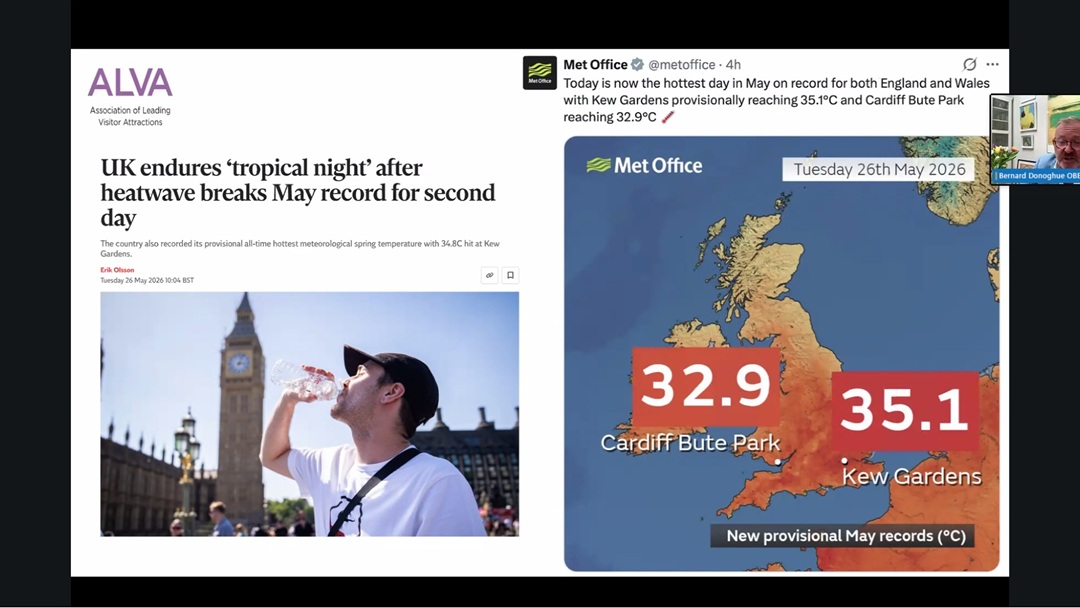
One of the most profound provocations of the opening session centred on the rapid operational threats posed by extreme weather volatility. With the previous summer confirmed as the UK's hottest on record, record-breaking spikes, such as recent peaks hitting 32.9°C in Cardiff and 35°C at Kew Gardens, are fundamentally changing guest behaviour.
During extreme heatwaves, indoor attractions suffer as expected, but outdoor venues face equal drops in footfall because consumers choose to stay home rather than face the discomfort of hot vehicles and public transport systems. Donoghue urged operators to stress-test their long-term financial models:
"If your business model is predicated on securing the bulk of your income during peak summer months, what do consistent 35°C to 40°C summers mean for your sustainability? Furthermore, how does your duty of care evolve regarding shade and hydration infrastructure for staff, volunteers, and guests?"
This risk extends into winter programming. While premium seasonal events, such as winter lights and specialised Halloween trails, continue to drive crucial revenue recovery, the increasing frequency of named winter storms makes these strategies highly vulnerable to forced cancellations and costly refund cycles.
Shifting Demographics: Redefining Value and the 'Non-Family' Market
Domestic overnight trip intentions dropped from 80% last year down to 75% in 2026, restricted by a 13% jump in petrol costs and a 24% surge in diesel prices. However, day-trip volumes remain highly resilient. Consumers are making tactical leisure choices, protecting their immediate local travel budgets to engage in what Donoghue called "deliberate memory-making experiences", spending special time with special people in special places.
To capture this highly selective spend, marketing leaders must look past legacy definitions of the attraction audience, focusing on two major demographic revelations:
The Evolution of the Family Structure
Collaborative research conducted alongside Baker Richards revealed that the traditional "family ticket", comprising two adults and two children, now only caters to 41% of active family groups. Modern leisure groups are increasingly diverse, characterised by a massive rise in multi-generational visits where affluent grandparents fund premium experiences for their adult children and grandchildren.
Crucially, 41% of families surveyed reported including at least one child with special educational needs (SEN) or neurodivergent requirements. This confirms that SEN provisions are no longer a niche tick-box exercise or a minority consideration; accessibility infrastructure is now a fundamental mainstream expectation that directly influences a family's booking commitment.
Targeting the 35–55 'Child-Free' Demographic
Complementing the family data, the conference highlighted critical insights into the 35–55 age bracket without dependent children. This represents the fastest-growing household demographic in the UK, while traditional households containing children continue to contract. Brand analysis showed that this affluent group is not repelled or deterred by the presence of families at attractions; rather, they simply seek distinct recognition, tailored communication, and an entry experience that validates them as independent guests.
Content Amplification: Replicating the 'Hero to Halo' Strategy
Maximising marketing output without overstretching internal creative resources was another cornerstone theme of the conference. In a highly practical plenary session, Danielle Nicholls, Senior Content Manager at Merlin Entertainments, outlined how attractions of any scale can leverage their core creative assets.
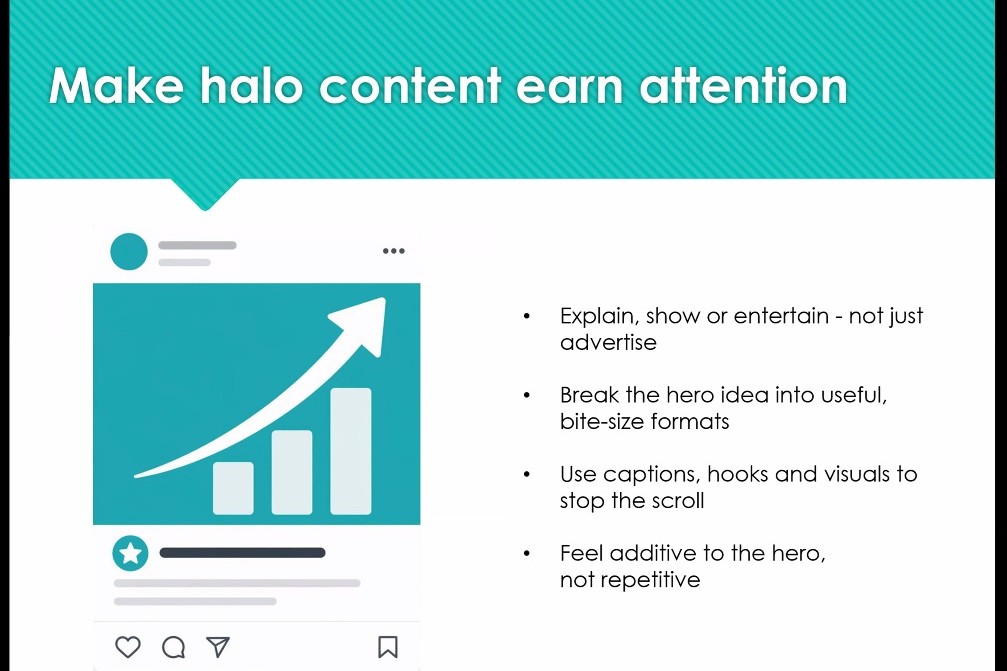
Nicholls introduced a production framework designed to strip the complexity out of multi-channel campaign management. The core methodology focuses on identifying a single, high-impact piece of "Hero Content", such as a headline ride launch, an exclusive behind-the-scenes seasonal broadcast, or a prominent IP brand partnership, and systematically breaking it down into mass "Halo Content" modules.
By dissecting a premium creative production into smaller, agile assets, marketing teams can feed all digital and social channels with ease. This ensures that a single creative investment stretches seamlessly across high-frequency platforms like TikTok, Instagram Reels, email lifecycles, and on-site web hubs, maintaining consistent brand impact while heavily protecting creative budgets.
Digital Ad Benchmarks: Are Your Campaigns Underperforming?
In a standout plenary session, Liz Dimes, Managing Director of Agility Marketing (a Gold Sponsor of the event), exclusively revealed the findings of the 2026 Visitor Attraction Digital Ad Survey. Now in its second year, this annual benchmark provides operators with a data-backed view of what "good" advertising metrics actually look like today, drawing from a vast dataset of UK theme parks, zoos, museums, heritage sites, and farm attractions.
The overarching trend is clear: the attraction sector is investing more heavily in digital advertising than ever before. However, Dimes emphasised that higher spend does not automatically equate to a smarter strategy or better performance. Larger attractions often concentrate budgets on scaling core platforms like Meta and Google Search, whereas smaller venues are demonstrating greater agility by experimenting with newer channels to capture distinct audiences.
Average Annual Digital Advertising Spend by Attraction Size
While spending ranges vary wildly within individual tiers, the survey mapped out logical baseline averages for annual digital ad budgets based on visitor volumes:
- Under 50k visitors: £1,000 to £5,000 average annual spend
- 50k to 100k visitors: £5,000 to £10,000 average annual spend
- 100k to 250k visitors: £10,000 to £20,000 average annual spend
- 250k to 500k visitors: £20,000 to £30,000 average annual spend
- 500k to 1m visitors: £30,000 to £50,000 average annual spend
- Over 1m visitors: £50,000+ average annual spend, with maximum spends scaling significantly higher
Meta Benchmarks (Facebook & Instagram)
Meta advertising remains completely ubiquitous, with 100% of surveyed attractions utilising Facebook and 98% active across both Facebook and Instagram. Because adoption is universal, base presence on Meta is no longer a competitive advantage; success depends entirely on execution, audience targeting, and campaign objectives.
- The Budgets: The cross-sector average annual spend on Meta sits above £30,000. While a large cluster of mid-sized venues spend between £5,000 and £10,000, a substantial portion of top-tier attractions exceed £75,000 annually. Conversely, 12% spend under £1,000 as a basic entry trial.
- Click-Through Rate (CTR): The sector benchmark for link clicks, specifically users clicking through to the attraction website, rather than basic post engagement, averages between 1% and 1.5%. High-performing campaigns regularly land in the 0.8% to 3% bracket.
- Cost Per Click (CPC): Link click costs have noticeably improved, dropping to an average range of 16p to 25p, down from the 25p to 50p averages recorded the previous year.
- Cost Per Acquisition (CPA): For attractions with accurate tracking, the standard cost per transaction, the cost to secure an online booking, rather than an individual ticket sale, sits firmly between £2.50 and £5.00.
- The Blind-Spend Problem: In a major structural improvement, the percentage of attractions unable to track their Meta ad conversions has plummeted from 44% last year to just 16% today. However, that remaining 16% represents an average blind media spend of £26,000 per attraction annually. Dimes warned that tracking gaps do more than harm ROI reporting; they actively starve the Meta algorithm of conversion data, preventing it from optimising delivery toward high-intent users.
The Google Search Brand-Term Trap
Google Search adoption grew year-on-year, pushing average annual search budgets down to a modest £1,000 to £5,000 as more operators stepped in to test the waters, though 13% of seasoned attractions continue to invest over £20,000. Despite this maturity, the survey exposed an expensive tactical error: 40% of UK attractions are failing to exclude their own brand name terms from their prospecting campaigns.
When brand terms are left unexcluded, the Google algorithm naturally funnels up to 80% of the campaign budget into those keywords. Because users searching for an attraction's exact name already possess high intent, click-through rates skyrocket and conversion costs plummet, creating highly misleading campaign reports. In reality, operators are paying premium rates for traffic they almost certainly would have captured organically for free.
To give operators a true picture of performance, Agility Marketing isolated the data to show the stark difference between campaigns that exclude brand keywords versus those that do not:
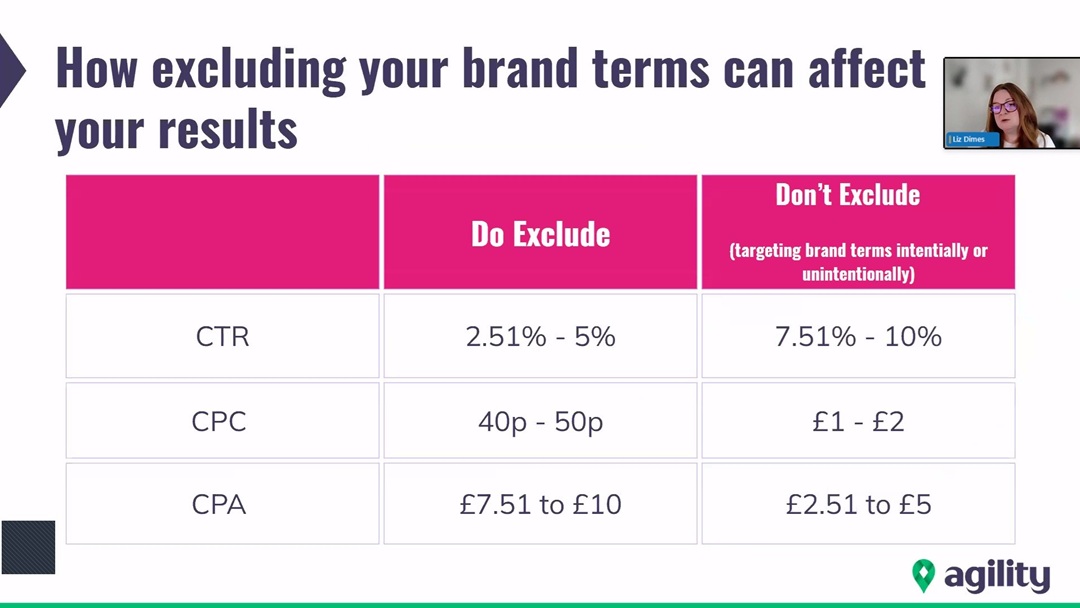
The strategic recommendation for attraction marketers is absolute: separate your brand bidding into an independent, isolated brand defence campaign with a dedicated budget if competitors are targeting your name. Keep your primary prospecting campaigns entirely free of brand keywords to ensure your budget is actively discovering new audiences.
Google Performance Max (PMax)
Google PMax usage mirrors standard search spends, averaging £1,000 to £5,000 per year. PMax channels content across Google's entire ecosystem, including Search, Display, Maps, Discover, YouTube, and Gmail. Tracking is highly mature here, with only 9% of attractions struggling to monitor performance.
- CTR & CPC: Click-through rates typically sit under 5%, representing a wide statistical spread based on asset usage, such as video inclusion forcing placements onto YouTube. The average cost per click mirrors search exactly at 11p to 15p.
- CPA: True conversion costs align closely with Meta, tracking at an average of £2.50 to £5.00, with top-performing, optimised setups driving conversions down into the £1.00 to £2.50 window. Marketers are urged to check search term reports within PMax to ensure the platform isn't covertly eating its budget on unexcluded brand search terms.
TikTok Ads: The Missed Awareness Opportunity
Despite TikTok boasting the highest daily usage time of any social platform in Europe, an average of 1 hour and 37 minutes per day, and global ad reach surging by 17.6% year-on-year in early 2026, only 42% of UK attractions currently utilise TikTok advertising. It represents the lowest budget allocation in the entire dataset.
Dimes expressed deep surprise at this gap, highlighting that TikTok currently offers the cheapest Cost Per Thousand Impressions (CPM) in the digital landscape, frequently tracking at 50% to 60% cheaper than Meta. It has also overtaken Facebook to become the second-highest platform used globally for brand and destination research, sitting just behind Instagram.
- The Benchmarks: Because clicking out of TikTok is less intuitive for users, the average CTR is lower, sitting between 0.4% and 0.8%. Average cost per click tracks slightly higher at 21p to 25p.
- Tracking & CPA: While 45% of attractions still encounter tracking hurdles on the platform, successful setups achieve a standard CPA baseline of £2.50 to £5.00. Even when CPA crosses the £30 threshold, Dimes notes the spend is heavily justified by the sheer volume of low-cost brand awareness generated at the top of the marketing funnel.
The Website Paradigm Shift: Stop Rebuilding, Start Evolving
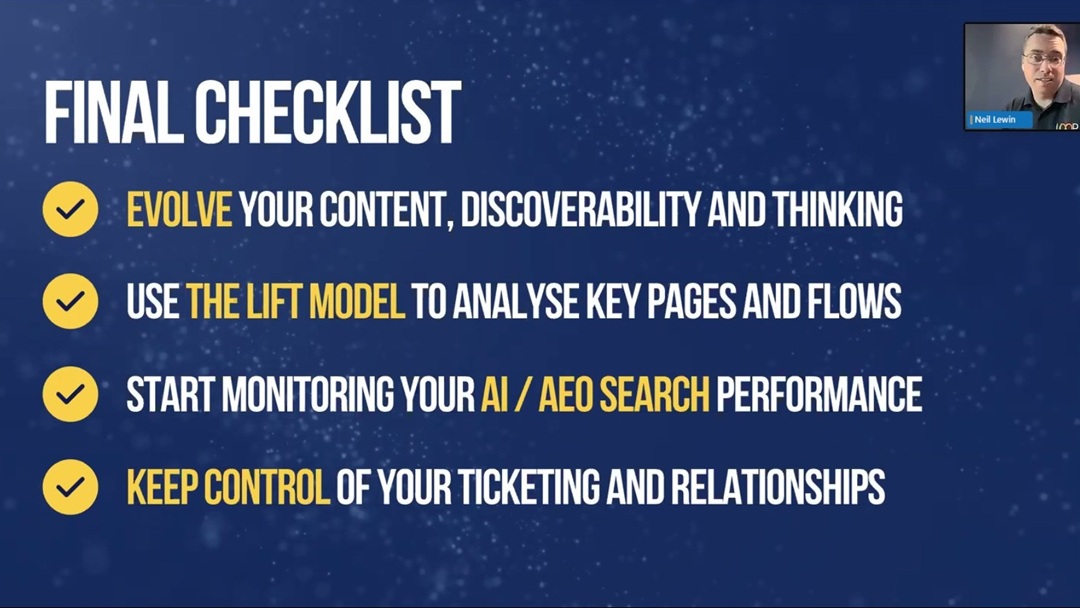
In a compelling afternoon plenary, Neil Lewin, Owner of Loop by Semantic (the conference Principal Sponsor), challenged the attraction industry's historical approach to web development. Lewin argued that the traditional cycle, where an attraction commissions an expensive, bespoke website rebuild every three to five years, is completely broken.
Because macro variables like mobile formatting rules, booking expectations, and now artificial intelligence are moving at a blistering speed, a static web build is often obsolete by the time it launches. It acts as a massive financial drain (CapEx), a resource distraction, and an operational risk. Instead, Lewin urged marketers to shift their mindsets and treat their primary digital channel as a living, breathing asset that undergoes continuous, incremental evolution.
The Website as an Answer Engine
The ultimate purpose of an attraction website is to act as an "answer engine" that turns organic demand into real-time visits, secondary spend, and repeat guests. This engine must simultaneously serve two completely different audiences on compact mobile screens:
- The Human Guest: Driven by emotional connection, visual verification, and frictionless functionality.
- The AI Discovery Bot: Driven purely by structured data, text consistency, and information integrity.
This dual focus is validated by alarming new data. Gartner predicts a 25% drop in overall website traffic due to the rise of AI assistants handling queries directly within search interfaces. Currently, 50% of all Google searches generate prominent AI overviews at the top of the results page, which has caused a 33% decline in click-through rates for the top organic search result. Furthermore, 60% of desktop and mobile search behaviour has turned into "zero-click searches," where a user's intent is immediately satisfied by a Google property, such as Maps, YouTube, or direct Answer boxes, without them ever landing on an external URL.
Simultaneously, ChatGPT search volumes are expanding aggressively, capturing half a billion more weekly active users year-on-year. Yet, despite this systemic shift, only 16% of brands currently monitor their performance within AI search engines. To bridge this gap, Lewin shared a critical tactical hack for marketers: directly query ChatGPT, Gemini, or Claude regarding your attraction niche. If your brand does not appear in the top recommendations, ask the AI model directly: "Why did you rank my competitors higher than me for this query?" The platform will instantly outline the explicit trust signals or content gaps you must address on your site to fix the ranking deficit.
Practical Action Plan: The Lift Model and On-Site Wins
To systematically evolve an existing website layout without entering a full migration project, Lewin highlighted the utility of the Lyft Model. Marketers must assess their primary conversion funnels against six core pillars to strip out friction and maximise bookings:
- Value Proposition: Is the core experiential offer instantly clear and compelling on a phone screen?
- Relevance: Does the page layout directly match the specific intent of the incoming traffic source?
- Clarity: Is the information, pricing, and next action completely unambiguous?
- Distraction: Are unnecessary links or busy visual modules drawing users away from the booking path?
- Anxiety: Are buried small print terms or sudden time-slot price spikes causing users to abandon the cart?
- Urgency: Are exclusive perks, time-limited windows, or capacity constraints driving immediate action?
By applying these principles, attractions can deploy several low-overhead content updates that immediately elevate performance:
- Deploy Accessibility Hubs: With 1 in 10 UK adults navigating a disability that impacts day-out decisions, setting up an accessible database with targeted maps, sensory details, transcribed video tours, and specific access FAQs is a major victory. Lewin noted that this requires less than half a day of CMS content work, yet it instantly eliminates booking anxiety for a massive market segment.
- Optimise Searchable FAQs: Clean, clear question-and-answer layouts don't just help human users find quick answers; they provide the optimal text structure for AI bots to scrape and pull directly into search summaries.
- Anchor with Decoy Pricing: Take a leaf out of the playbooks of major operators like Merlin Entertainments and Continuum Attractions. By introducing a premium, high-value package tier first, you create an immediate psychological anchor point. This high-tier reference point elevates the perceived value of your standard packages, driving stronger average order values.
- Preserve Permanent URLs for Events: Avoid creating new web paths for recurring seasonal features. Maintain permanent directories like
/halloweenand/christmasyear-on-year. This allows long-term organic authority and search engine indexing to accumulate indefinitely rather than resetting to zero annually.
Driving the Nudge: Immediate Tactical Action Points
In a powerful afternoon keynote, Simon Jones, Managing Director of Navigate Agency, tackled the erratic landscape head-on by exploring rapidly changing audience habits, emerging growth markets, and strategies to cut through an increasingly competitive visitor market. He emphasised that whilst macro uncertainties require long-term agility, there are immediate actions operators can deploy to optimise conversion and protect profitability:
- Monetise the 4-Hour Nudge Window: Modern consumers plan early but commit incredibly late. Research indicates that while families browse and research destinations up to four weeks in advance, they do not make an emotional or financial booking commitment until a window of 4 to 24 hours before arrival. High-frequency social media prompts and targeted afternoon-before pushes are essential to convert this late-stage intent.
- Focus on 'Value for Joy' Over Base Price: Base ticket pricing above £35 per person remains completely viable across the sector, provided the on-site narrative justifies the spend. The consumer focus in 2026 is not centred strictly on low cost, but on robust value for money and experiential return.
- Target the Premium 20%: Approximately 20% of the domestic population remains insulated from cost-of-living constraints. While their retail basket sizes have decreased slightly, their overall spend remains high, driven by an appetite for behind-the-scenes tours, exclusive retail items, and premium upgrades. Capturing this requires flawless execution, as their quality expectations have risen alongside their investment.
- Remove Friction and Digital Scepticism with Authenticity: Consumers are increasingly distrustful of highly polished, AI-generated creative. Ad creative that features raw, real, visitor-generated content or organic staff voices regularly outperforms studio-produced media. To dismantle booking doubt, ads must quickly answer three core questions: What does the experience actually look like? Is it right for my specific group? Is it worth the money?
- Build Campaign Elasticity for 'Rain or Shine': Leading operators are achieving stronger returns by building creative "rainy day" and "sunshine" asset backups. When a weekend forecast shifts, agile marketers pause standard messaging in real time to deploy weather-appropriate ads, matching localised realities instantly.
- Account for Meta's New 2% UK Regulatory Charge: Marketers must review their media budgets ahead of the summer peak. Effective 1 July 2026, Meta is introducing a mandatory 2% location fee on all UK media spend to account for local regulatory and privacy overheads. If your budget caps are strictly fixed, media delivery settings must be reduced by 2% to absorb the billing change without overspending.
- Implement the Under-60-Second Mobile Mandate: With the vast majority of spontaneous traffic browsing via smartphone, booking funnels must be ruthlessly optimised. If a visitor cannot move from inspiration to fully "booked" on a mobile device in under 60 seconds, conversion rates plummet as they move on to a competitor.
Beyond the Plenaries: Essential Seminars to Watch Back
Beyond the core keynotes, the conference featured a wealth of highly practical seminars packed with sector-specific growth opportunities.
For attractions looking to optimise niche channels, James Hobbs (Aer Studios) delivered an eye-opening guide to digital sustainability and website auditing, whilst Tom Sanderson (The School Trip) shared a proven framework for driving direct teacher engagement to unlock school booking pipelines.
Real-world commercial innovation was on full display as Rachel Wood (Doncaster Culture and Leisure Trust) revealed how a single venue generated £30,000 in its first year by leveraging WhatsApp Channels for exclusive discounts and visitor updates. Marketers looking to stretch finite budgets can learn how to build highly collaborative, productive partnerships from Laura Baxter and Dominic Wray's session on maximising regional Destination Marketing Organisations (DMOs).
Finally, cultural sector professionals can dive into broader consumer shifts via Christina Lister’s breakdown of five key museum audience trends, or explore a beautifully blended approach to physical and digital storytelling in "The Space in Between", co-presented by Sandra Lynes Timbrell (St Paul’s Cathedral), Bala McAlinn (Complete Works), and Spencer Clark (ATS Heritage).
All of these brilliant sessions were recorded and remain available to stream via the event lobby until 31 July 2026.
Industry Outlook
The clear consensus from the National Attractions Marketing Conference 2026 is that traditional operational assumptions are losing their utility. Whether adapting to legislative updates, building climate-resilient event calendars, or restructuring ticket models to reflect modern generational wealth splits, success belongs to agile operators.
If you feel like you missed out, you can still get tickets to access all of the amazing content by clicking register.